Product · Sales Operations Platform
PlaybookOS
A platform that turns a sales script into a working system: designed as a branching playbook, published as a fixed version, run by a rep during the call, and improved from what actually happened.
- Status
- Live
- Year
- 2026
Context
A sales script is written as a document and used as a decision tree. The moment a conversation branches, a linear document cannot follow it — so reps stop using it, managers cannot tell which version was in play, and nothing learned on a call makes it back into the script.
Approach
PlaybookOS treats the script as data. A playbook is drawn as a graph of stages, questions, objections and offers; publishing freezes it into a version that never changes again; a runner serves that version to the rep without showing them the graph; and every conversation is recorded against the version it ran on, so analytics compare like with like. AI proposes changes — a human approves them into the next draft.
Design decisions
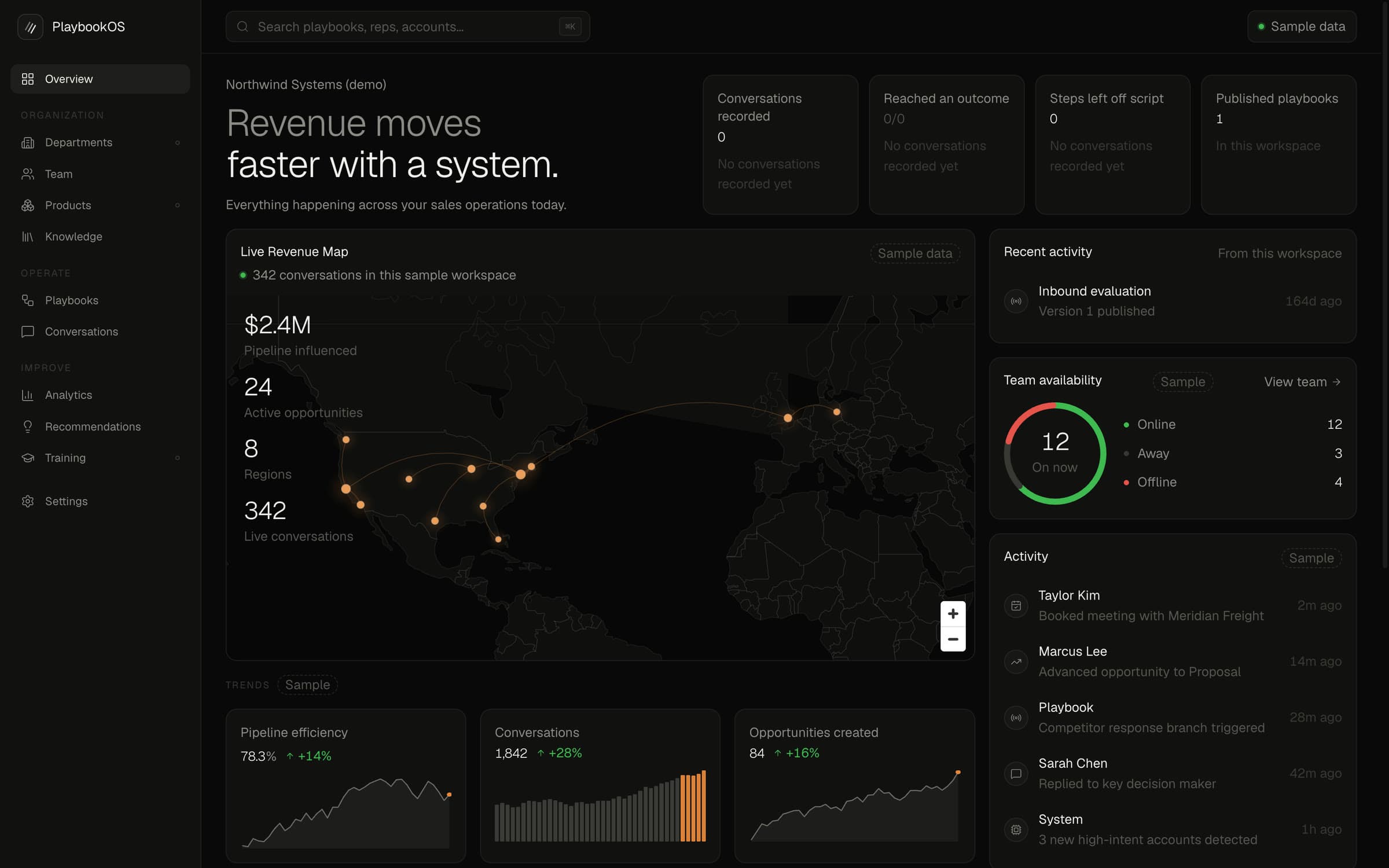
- A dark operations shell: overview, playbooks, conversations, analytics, team, knowledge
- A canvas-based builder with a block library and live validation before publishing
- Every sample figure is labelled as sample, on the screen where it appears
- Tokens, not hex values: one design system across landing, shell and builder
Engineering
- Next.js App Router with a typed domain model as the single source of truth
- PostgreSQL with strict tenant isolation and role-based permissions
- Email sign-up, verification and invitations over a verified sending domain
- Nightly off-platform backups that are restored and checked automatically
Key interactions
- Drag blocks onto the canvas or click to append; branches are drawn edge to edge
- Publish freezes a draft; editing branches the next one
- Run a published playbook step by step, with outcomes recorded
- Open sample workspace — no account needed to look around
Technology
- Next.js
- TypeScript
- PostgreSQL
- Drizzle
- Better Auth
- Resend
- MapLibre
- Render